Monday, August 10, 2015

Things I've Learned While On Hold To Speak With The IRS


Of these only three are considered "Literature & Fiction." There are 42 biography/memoirs on the list. Poetry doesn't appear at all.

2.  The subject of an interview I'm doing is much smarter than I am.

3. The IRS plays an instrumental composition that seems designed to make one aware of the passage of time. It loops through with single notes played on what seems to be an electronic piano. It sounds like David Benoit. Occassionaly there's a sort of hint that the music is coming to an end. But it doesn't.

4. A blog called TaxGirl.com has a post from 2010 discussing the on-hold music in some details (that's where I got the David Benoit reference. I've never actually listened to the easy jazz stylings of David Benoit on purpose, and after this I probably never will (though the little bongo solo made me laugh because it reminded me of Dr. Sheldon Cooper's epic bongo moment on "The Big Bang Theory").

5. There are many "IRS customers."

6. Apparently there is internal IRS hold music, also. This I learned from the comments on the TaxGirl.com post.

7. If you file married filing jointly, always make your payments under the FIRST Social Security that appears on the return—even if it's not yours. 

8. Goo Goo Clusters are made in Nashville. There are three types: Original (introduced in 1912) that combiness milk chocolate, caremel, peanutes, and marshmallow nougat; Premium (introduced int he early '80s) has pecans instead of peanuts; and Peanut Butter (introduced in 1991) replaces the nougat with peanut butter. A 72-count box of any flavor costs $95.99 (not including shipping), but you can also buy Collector's Tins that contain an assortment. The Collector Tins are not in stock. From April through September, the company offers the option of a $10 "warm weather" charge for orders shipped in insulated shippers with cold packs. googoo.com

9. PAWS in Norwalk is hiring a Canine Adoption Coordinator. It's a salaried position. http://pawsct.org/

10. The Connecticut Department of Transportation is announcing the nighttime closure of the Scribner Avenue on-ramp to I-95 Northbound (Interchange 14) in Norwalk from 9:00pm until 6:00 am beginning Monday, August 10, 2015, and ending by Friday, August 14, 2015.

11. Erika Dreifus is not only a generous person (on her blog she posts a list of paying markets for writers every Monday), she is an incredible writer. You should check out her work: http://www.erikadreifus.com/publications/

12.  " Currently, an adjunct in the College of Liberal Arts is paid about $4,000 per semester to teach a three-credit course. The cost to a student for such a course is approximately $3,000. If 30 students enroll in the course, the university derives $90,000 from that course alone. Deducting the adjunct’s fee of $4,000 from the total leaves the university with $86,000 (minus a relatively small amount for the administrative and building costs attributable to the use of the classroom). The adjunct receives no health or retirement benefits.
If you apply the same calculations to 500 adjuncts, the results are astounding. If each teaches but a single class of similar size (some teach two or more), the income to the university per semester ($90,000 multiplied by 500) is $45 million. The total cost for adjuncts ($4,000 multiplied by 500) is $2 million. That leaves the university with $43 million per semester." Read this: Universities that rely on adjunct professors pursue profit over academic integrity by Samuel Hazo

13. I really need to change my jobs situation. 

Thursday, August 21, 2014

As I prepare for the new semester, this "Shadow Syllabus" by my friend and colleague, Sonya Huber, is making me feel so much better about everything.

Thursday, September 5, 2013

Julia Child Rule No. 3: Learn to Be Amused


Here it is Sept. 5 and I’m already running behind with blogging about #Live Like Julia*. I am also running behind on:

·     Writing the 2015 Inner Bitch calendar

·     Revising my novel
Working on an essay or two that I have in progress

·     Getting all the “administrative” tasks related to teaching done

·     Reading for work and pleasure

·     And a few other things that have slipped my mind at the moment, but which I will probably remember as I’m trying to fall asleep tonight.


How am I ever going to make anything of myself?


This is the question I’ve been asking for, oh, a couple of decades or so. Actually, it’s the question I’ve been asking since I first became aware that I was not living up to my potential—a point made clear in the comments section of my fourth grade report card. There were, of course, what I’ll call “extenuating circumstances” that made it difficult to live up to whatever potential I may have had—my mother’s mental illness left me too confused and angry and alone to really concentrate on school work. Yet I felt ashamed when I handed that report card over to my father, whose position was that, since all I had to do was school, it was my job to get straight A’s. He looked at the grades, read the comment, and said, “Remember this: Perfection is acceptable.”


I won’t bore you with the gory details (that’s what the unpublished memoir is for) but things went downhill from there. And I find myself at 57 (57!) still grappling, as Julia did, with “the stark choice of whether to be a wallflower or a myth.”


As the new semester begins, I am once again aware of the tenuous nature of my “career.” I teach as an adjunct at three Institutes of Higher Education (IHE) and am once again juggling the considerable demands of too many classes and what feels like 1,000 students for earnings that are embarrassingly paltry, allegedly so I don’t have to take a full-time job that would get in the way of my writing. Because writing is what I really “do”—or so I claim. Yet there is no time to write during the semester. 


So I am, once again, wondering how I am ever going to make something of myself? It’s too late to even dream of a tenure-track position that would provide a reasonable course load and a salary I could live on  (trust me on this). Though I’m more than proud of the Inner Bitch books (Still in print after nearly 20 years! Life-changing for women around the world!), I believe that the writing I’m doing now—“serious” writing a/k/a literary writing—is what I’m really meant to do, but the struggle to simply make financial ends meet gets in the way. But I’m afraid I’m running out of time.


Yet there is this: joy. And there is this: pleasure. As Karen Karbo writes in Rule # 3 of Julia Child Rules, Lessons on Savoring Life: “…learn to be amused and find things that bring you pleasure. Each day I have the choice to recognize joy and to find things that bring me pleasure. So even on The Longest Day of the Week (out of the house at 8 a.m., back home at 9 p.m.), I took the time to be amused by:

·     The endless enthusiasm of the Wondergrandson (who, at 2, finds delight in so many “small” things)

·     The sheer joy of being in the presence of the Wondergranddaughter (who, at 18, is just awesome) and the Wonderdaughter (who is equally awesome)
The comfort of the Total Package
My students—who I look forward to getting to know

I made sure to find pleasure, too. Look at this adorable breakfast I packed:
Greek yogurt and granola in the sweetest Mason jar ever. Plus grapes, iced green tea, and a little light reading. 
And I take comfort in remembering that Julia—who was a lifeline for the lost little girl I was in the fourth grade—didn’t become a myth until she was 51.

* Check out more about Live Like Julia here.


Tuesday, July 16, 2013

Protective Covering


Since becoming an adult (which was quite a long while ago, now) I have prided myself on this one thing: my firm handshake. Though I appear to be a gregarious person that’s just protective covering for an essential shyness; I am deeply shy but I’m lucky that I’m also deeply curious about people. Early on, I learned that the best way to deal with the shyness was by engaging others quickly, to get them talking so I could listen. That firm handshake was a kind of armor I donned before going out in public; combined with a smile, looking a person straight in the eyes, and a leading question it was the fastest route to my safe haven of observation.

My father coached me in the art of the handshake (yes, this is a thing we did, randomly—I’d walk into the kitchen or pass him in the yard and he reach out his hand for a shake, then he would give me his comments on my technique), warning me to “never shake hands like a woman; don’t do that awful thing where they wrap the first two knuckles over someone’s fingertips and give a little squeeze, and never give a limp-fish handshake—you might as well announce that you’re a pushover who’ll do anything they want you to do. A good handshake is like a declaration of confidence.” His judgment of “bad handshakes” passed straight into me through our palms; I have written off people completely based on their handshakes.

A little over a year ago, however, shaking hands became painful. The quick cupping of palms was all right, but the pressure of another person’s fingers on mine made me wince. I thought it must be too much typing or the endless writing of comments on print copies of student papers, an occupational hazard, so I began to do stretching exercises and squeezing a stress ball to try to strengthen my digits. Naturally, I kept on shaking hands when being introduced to someone and when greeting acquaintances; my grip just as certain as always, despite a momentary hesitation—a limp handshake remained too embarrassing to consider and the pain was fleeting.  After a while, though, I realized that the joints in my fingers hurt—not just when in use but often upon waking. In fact, my first thought upon waking was something like, “Oooowww;” the pain was everywhere.

That’s when I went to my doctor (a thing I’ve avoided doing as much as possible—though I had seen her relatively recently when I thought I had pneumonia; she diagnosed pleurisy). She suspected fibromyalgia; it turned out I have psoriatic arthritis—an inflammatory disease that can lead to joint damage (the photos of that joint damage are…awful). One of the symptoms is chronic pain in the affected joints; it turns out that the inflammation can affect the lungs—thus the pleurisy.

There are days when the pain is so insistent and intense that I can barely bring myself to speak to people I know and love. It’s not just joint pain, either; I often feel as if I’m coming down with/am getting over/am laid flat by the flu. All of which is awful enough but the thing I’m resenting today is the loss of my firm handshake. The idea of offering my pained hand to someone who does not know to handle it with care intimidates me. It feels as if my armor has eroded, leaving me to deal with my shyness in new ways. Except I haven’t quite figured out what the new ways will be.

Saturday, May 11, 2013

Mother's Day

For Shannon, still the best thing I have ever done. Thank you for every minute.


The first time I see my baby, a nurse brings her into my room, lays her down at the foot of the bed and says, “Well, here she is.”
A face. Pink. A hand. Also pink.
I stretch my arms toward the bundle, toward that face.
“Better not,” the nurse warns. “We just fed her and she’s beginning to fall asleep.” But she undoes the tight swaddling blanket and even the diaper to show me that this baby is, in fact, a baby girl.
“Beautiful,” I say.
I watch the baby’s arms tracing jerking circles and ask the nurse to wrap her up again because I can tell she’s cold. And the nurse takes her out of the room.

The second time I see my baby is a day later in the nurses’ break room. A group of mothers, all of us dressed in robes and slippers, sit on wooden chairs pushed into jumbled rows in front of a long table. On the table there’s a plastic bathinette, a pink plastic bottle of baby soap, two towels laid out and two baby washcloths. New Nurse bustles in, holding my baby in both arms. She stands on the other side of that long table, rocking my baby gently and I look at my daughter’s head resting on that white-sleeved elbow. With her other hand, New Nurse pats the rhythm of a heartbeat on my baby’s swaddled bottom. 
Then she shifts my baby over onto one arm, holding her like a football while she grabs a clear plastic pitcher and carries it to the sink. “You never want to wash Baby in the sink, because it’s too hard and deep and Baby is slippery,” she says over the gush of running water. She has her back to me and I crane my head forward to try to catch a glimpse of my baby but all I can see is the blanket wrapped tight around her feet.
“I can hold her while you do that,” I say, but New Nurse either doesn’t hear or she’s ignoring me.
“This is how you test the heat,” New Nurse dipped her wrist in the water. Then she unwrapped my baby and all the mothers oohed and ahed.
“That can’t be a newborn, look at the size of her!” one of them giggles.
“She weighs nine pounds eight ounces, and she’s 22 inches long,” I say. 
“She’s yours?”
“Yes. She’s mine.” I watch my baby slip into the water, eyes wide open, mouth shut tight, her arms waving and her head moving from side to side like she is looking for something she’s lost.
 
I should just walk down there and look at her. They can’t stop me from doing that.
 I’m sitting in the hospital bed trying to convince myself that seeing my baby would be just that easy when Dr. Baker, the pediatrician, comes into my room and perches on the edge of the bed. “Elizabeth. That’s some baby you had!”
I nod, ready for him to start talking about how great adoption is. If I had him for a husband, a handsome and rich doctor with straight white teeth and blue eyes, no one would be talking adoption. 
“She’s gorgeous,” he says. “Are you breast-feeding?”
“I haven’t even held her yet.”
 “What?”
“They won’t let me hold her.” The tears start and I gulp hard against the tightness that spreads from my throat into my chest.
“Who won’t let you hold her?” He leans toward me, his hand on my arm, his forehead bunched in a way that makes me wonder if he thinks I’m crazy.
“The nurses.” Not crying is impossible now.
“Well, that’s bullshit!” And he’s off the bed, out the door. The sudden shifting of the mattress sends a jolt of pain so fierce I have to grab the pillow and press it hard against the thirty-two steel clamps in my belly.
A minute later I hear New Nurse practically shout. “But Doctor! Doctor!” Then it’s her voice then his voice and the footsteps coming closer.
He stands in the doorway for a second, holding the tight white bundle that is my baby firmly against his chest and I wait for him to keep her there just out of reach, ready to have him not hand her over to me. “You’ll be more comfortable with your back against the pillows,” he says. I maneuver myself, moving fast in spite of the pain, and he puts her in my arms then walks out without a word, pulling the door shut behind him.
Solid. She is so solid. She’s twisting her head in a kind of figure eight and I can feel her arms move under the blanket. I lay her on my legs, unwrap her the way I’ve seen the nurses do it.
A halo of strawberry blonde fuzz swirls across her skull and there’s a bruise on her left cheek. I lift her closer, press my lips as gently as I can against the purplish splotch, feel the tickle of her hair on my cheek. She makes the tiniest squeak ever and I hold her closer, inhale the smell of her—sweet and salt and something I have always known but cannot name—and that smell is so so good, so much better than anything I have ever smelled before.
With one arm I wrap her close, run my hand over her right arm, squeeze lightly, my mouth following the path, tasting her skin, memorizing her flesh, the suggestion of bone so close to the surface. I press my fingers into the hollows of her ribs and can feel her heart flutter against my fingertips.
I feel her legs, check her toes, discover the wonder of toenails, kiss the bottoms of her feet.
Say something.
I want to tell her that I am so happy she is here.
I want to tell her that we are going to be okay, she and I.
I want to tell her that I will be as strong and brave for her as I know how to be.
I want to tell her that I will love her forever, no matter what.
I want to make sure that I say the right thing.
“Hello, baby,” I whisper.
She stops moving her head and I look into those eyes that still have all of heaven in them. ““Hello, Shannon, I’m your mother.”


Sunday, January 13, 2013

Snow Boulder


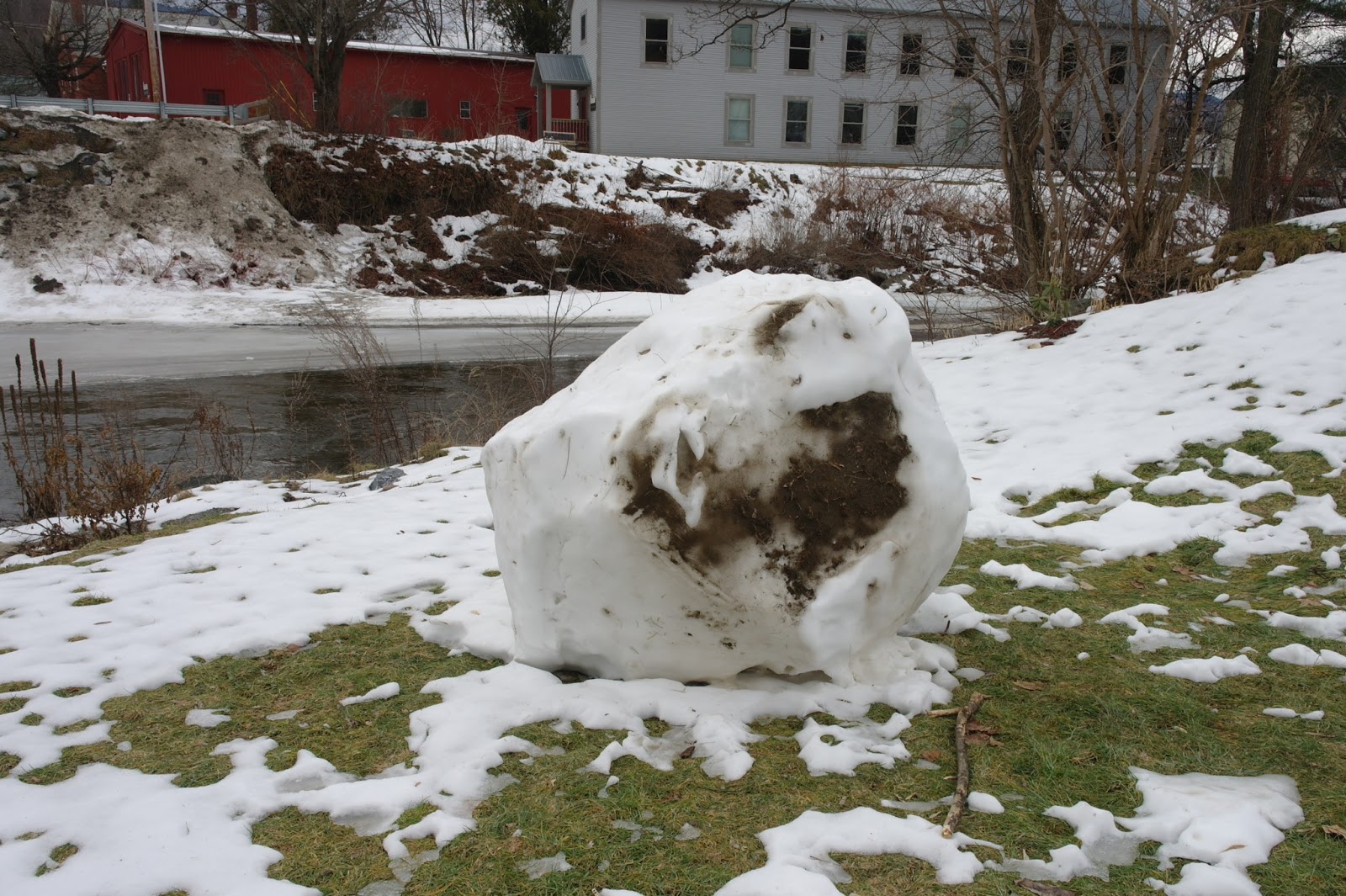
I’m sitting in “my” studio at Vermont Studio Center, a snug room in a sturdy, no-nonsense building that will, for me, always “mean Vermont.” Through the ample window—about six feet tall, four feet wide—I look out on a view of a determined ice-rimmed river; on the other side, on the broad swath of lawn between a building that houses the studios of artists (not writers), a group of five hale and hearty writers and artists are grappling with an enormous snowball. Another artist, the one who has set all this in motion, circles this endeavor taking photos.

I am waiting for the moment when the snowball succumbs to the pull of gravity and tumbles down the slope of the lawn into the river. From here, this seems an inevitable thing, though I cannot be certain. Some of the snowballers kneel in the snow that has grown wetter and heavier in the January thaw that has set this part of the world dripping. The others lean into the work of pushing and, together, they all move the snowball (growing bigger with every rotation) a few inches then regroup and approach it in different configurations. In the last two days of (relative) warmth, some of what had been a lid of thick ice—marbled, translucent, beautiful—has broken free and been carried along the surface of the narrow of open water. There is a point where the river curves and narrows; these ice floes are trapped by some coincidence of shallows and more adamant ice. Below this winter-made dam, the river water has been freed by the warmth and I can see it’s rocky bed.

Through the window I hear the shout I’ve been anticipating—triumph! I look out in time to see the snow boulder teeter then speed down the small hill and I think, “Oh, it will splash! It will break that ice dam!” At the bottom of the hill, though, is a plateau and the snow boulder halts abruptly.

The workers rush down the slope and begin grooming their creation, patting and smoothing it as if it were an animal for which they have been caring. Then they climb back up the hill and a few—the men—begin to pelt the boulder with snowballs. The artist who conceived of this project, hands off the camera, slides down the hill and poses with the boulder, fending off, then trying to catch some of the snow balls. Everyone loiters, pushing snow with their booted feet, peering down toward the snow boulder that is now planted in a spot that would, in summer, probably be ideal for a picnic. 
The snow boulder with "my" studio (second window on the first floor) in the background—courtesy of the artist, Anneke Muijlwijk.

I can’t wait to see how this thing, this shared act of art, turns up in the work.

Sunday, July 22, 2012

One Year Later

In honor of the first birthday of the Wondergrandson, I offer this repost:

No Ketchup

One waits, the waiting accompanied by a pulsing of anticipation/excitement/worry.

Seven months ago I waited for this to be done:


Once the snow melted, I began to wait for these:


Today I waited for my grandson to be born.

This was different than when my granddaughter was born. Sixteen years have passed and life has changed, of course. On that day I was an active participant in the birth and while the pulsing was certainly there, my attention was on my daughter, my focus was keenly on her and the incredible ordinary magic of the process.

Today I waited. I sat on the couch in my living room working while the dog and cats slept nearby, the historic heat pressed its estimable weight on the world and, a few short miles away, my daughter once again labored through the incredible ordinary magic of giving birth. The pulsing this time was nearly deafening, pulling my mind and heart away from the work at hand. When the pulsing overwhelmed, I called friends and talked until it was just a hum in the background.

In the evening family assembled—my daughter's sister and aunt, my husband, Florida Freddy. We ate pizza, we laughed, we talked. We waited together. Then a point came when I knew I had to go to the hospital—worry had overwhelmed all the other elements of waiting. I drove the few miles, walked in to the labor/delivery room, checked out what was going on and, after a little while, came home again.

Two hours later my phone buzzed. "Baby's here. Shannon says Wendy's, please."

We all piled into one car and headed for the drive through. I spoke into the intercom, gave the order. "A #1 with cheese and no onions."

"No ketchup?"

"No. No onions."

Shannon's aunt said, "Where did she get 'no ketchup?'" 

We all laughed, releasing the swirl of anticipation and excitement (no more worry). We laughed again when the two giant cups of soda were passed out of the drive through window. We laughed again when we saw the sign proclaiming that ketchup and salt were available by request. We even laughed when we got stuck behind a man on a motorcycle following the white line on the right side of the road at 10 mph in a 35 zone—though our laughter was once again tinged with worry.

In the vestibule we had to wait to be allowed in—a group of five giddy adults carrying tubs of soda and a paper sack redolent of grease and salt, surrounded by a pulsing halo of excitement and anticipation that was surely visible.

Down the hall, the nurses calling congratulations from their station and then the waiting was over and there was this:


Look at those eyes. Look at the old soul peering out from inside.


When I held him for the first time, I felt a pulsing made of wonder and gratitude and the incredible ordinary magic of love.

Tuesday, July 17, 2012

Oh, Joy

I've been a little blue lately—a convergence of situations, the alignment of the stars, some physical challenges—which has, of course, made writing hard so I've had no energy left for blogging. The last three days, however, have been a tonic.

Sunday The Total Package and I went with friends to one of my favorite restaurants (Skappo) before going to hear two of my favorite musicians in the world—Cory Chisel and Ade Denae—play in a very  small club in New Haven, followed by the second course with some wonderful wine and incredible, deep, soul-nourishing conversation (at 116 Crown).

Monday I taught then drove to Mystic for dinner with one of my favorite people in the world, Baron Wormser, and a new friend, Thom Bassett. Both Thom and I were lucky enough to have had Baron as our mentor (at different times and at different MFA programs)—now I'm lucky to have found another friend who is deeply engaged with writing who's willing to share work, insights and advice, and who has a wicked good sense of humor. Every time I have a chance to talk with Baron his wisdom, generosity and writing makes me want to try harder to be a better writer and a better person. (Of course there's a link to follow to learn more about Baron's extraordinary work; check it out and you'll see what I mean.) The conversation ranged from Faulkner and Hawthorne through country music and Emerson; more nourishment for the soul, plus a side order of inspiration—all three of us teach and Baron reminded me about what a privilege it is to be able to do so.

Today was all about connections—with The Total Package, with friends, with Nature her own self. I went to teach my class and found the gift of a former student visiting—a reminder that teaching is another form of connection.

The WonderDaughter and the WonderGrandchildren are returning from a week away and I can't wait to see them, so I was excited to be done with class. The drive home along back roads felt like an adventure—the way driving at night felt when I first took my place behind the wheel. "Yes," I thought. "Yes, I am lucky."

When I pulled in the driveway The Total Package came out to greet me.

"I think we have to go to the grocery store," he said. "The dog got skunked."

One vinegar-infused bath and countless sprays of various aerosols later, the dog is in his crate (in the garage, poor lamb). The house stinks beyond description. The "kids" are on their way from the airport. And I am beyond lucky, I am blessed.

Wednesday, May 9, 2012

Live Psychic Live!

I just checked a website that one of my students used for a research paper and found an ad for live psychics—on camera, waiting for my call, drinking off-brand colas, hollering over a shoulder to someone in another room, surrounded by statuettes proclaiming someone The World's Best Mom.

All I had to do was click on the image and I could have signed in, gotten news from the Universe.

The thing is, I don't think I want to know.

Monday, April 2, 2012

Flash Something XII—Not really a flash at all

Lee Bessette has called for today to be the Day for Higher Ed and asked for academics "to actually record, in minutia, what we do as professors from the moment we wake up to the minute we fall asleep. All the work we do that contributes to our job as educators."

So, here goes: I am an adjunct professor, teaching part time at three different schools—I teach different courses at each school and have approximately 20 students in each of my four classes. I have no benefits, no paid vacations, no paid sick days, no certainty that I will be rehired at any of these schools next semester.

6:15 a.m.: Wake up. On Mondays, I teach only one class at 8:30 a.m. While I drink my first cup of coffee I check the bag I've dedicated to this school (I teach at three so let's call this School #1) to make sure I have everything I'll need packed and ready to go. That means I do an inventory of whiteboard pens, extra assignment sheets (all of them, from the beginning of the semester), the portfolio a student from two semesters ago has asked me to return to her. I have no office at this school so I have to store student portfolios (a semester's worth of work) in my home office for a full year because that's policy.

6:30 a.m.: Second cup of coffee. Log on to email for School #1—it's a contractual requirement that I check this email at least once a day but I always check it three times a day because when students send emails they usually need a timely response—no new emails. Log on to email for School #2; there are eight new emails from students since I logged on last night before bed. Answer the questions, one student can't find a book he needs for his big project so I agree to lend him my copy (which I agree to drop of later in the day) and, since I'm delivering that book, arrange to meet with students later in the day (though I don't have office hours on days when I don't teach at School #2). Check email for School #3; no new emails from students but some administrative tasks to handle. Look for book and realize that I loaned my copy to a friend; log on to School #2 bookstore site to see if they have book in stock.

7:35 a.m.: Shower, dress, grab a bottle of water and my class bag, drive to School #1.

8:05 a.m.: Unlock classroom door, boot up computer and write notes on white board to supplement projected notes on the day's lesson. Because I have no office here, I try to get to class early enough to meet with students; few of them email to arrange for this so I simply make myself available.

8:30 a.m.: Lots of questions about the projects that are due next week. Because only two students have read assignment I alter teaching plan for the day—while they read the shortest of the stories assigned and journal their responses, I return previous assignments. There are 24 students enrolled in this class; I spent approximately six hours responding to the assignments I am returning now. I spent an additional two-three hours preparing my lesson plan.

10:15 a.m.: Some after-class discussions with students (always awkward since there is no privacy) and a visit from a former student who wants to advice about where to transfer. We walk and talk so I can put the portfolio from two semesters ago on a shelf in faculty services (where its rightful owner can retrieve it), then walk and talk some more.

10:30 a.m.: Drive to the appointment I made for 11 thinking I'd have time to pick up a smoothie or something en route—the drive takes 25 minutes so no smoothie for me. Get a text asking if I can meet with a colleague at School #2; feel lucky to be able to say I can meet because our schedules do not overlap and it has been months since we talked.

1 p.m.: Go to bookstore to pick up book, pick up lunch which I hope to be able to eat in the office I share with two other adjuncts at School #2 before the first student I'm meeting with arrives for our meeting at 1:15. Drop book in my mailbox with a note for student. Back in office, log on to email—there are six new emails from students that I answer while I eat. Print out submissions for writing contest I'm helping judge.

1:45: Student never showed. I meet with colleague.

3:00: Back in office; have email from 1:15-meeting student apologizing for forgetting our meeting and asking if we can reschedule for 1:45. The email is time-stamped 2:30. Answer four more emails from students.

4:00: Pack up writing contest submissions, drive home. Check emails for Schools #1 and 3. Check bag dedicated to School #2 to make sure I have all the papers I've graded/commented on, handouts, and other necessary materials for classes tomorrow.

5:00: Read book that is assigned for class at School #3, make notes for lesson plan.

6:00: Realize I have made no plans for dinner. Family decides diner is best option.

8:15: Back from dinner, log on to School #2 email, answer two new student emails. Log on to School #1 email, answer one student email; log on to School #3 email, answer one student email.

8:30: Realize I have not written anything today. Read Sonya Huber's terrific blog about her day of Higher Ed and figure this is as good a thing to write about as any.

10:00: Begin writing this blog entry.

11:30: Finish writing this blog entry.


Sunday, April 1, 2012

Missing in Action

No new posts for days because Mr. Handsome Man, my beloved cat, had a health emergency and there is no writing in that circumstance.

He is better, for which I am grateful, but this is going to be a "thing."

Thursday, March 29, 2012

Flash XI—In Memorium

Because there's nothing I could write that comes close to this:

What Kind of Times Are These

By Adrienne Rich

There's a place between two stands of trees where the grass grows uphill
and the old revolutionary road breaks off into shadows
near a meeting-house abandoned by the persecuted
who disappeared into those shadows.

I've walked there picking mushrooms at the edge of dread, but don't be fooled
this isn't a Russian poem, this is not somewhere else but here,
our country moving closer to its own truth and dread,
its own ways of making people disappear.

I won't tell you where the place is, the dark mesh of the woods
meeting the unmarked strip of light—
ghost-ridden crossroads, leafmold paradise:
I know already who wants to buy it, sell it, make it disappear.

And I won't tell you where it is, so why do I tell you
anything? Because you still listen, because in times like these
to have you listen at all, it's necessary
to talk about trees.


Thank you, Ms. Rich.

Tuesday, March 27, 2012

Flash X—Fairy Tale

Julia Roberts is playing the Wicked Stepmother. So is Charlize Theron. There are two prime time TV shows "inspired" by fairy tales—a wellspring, it seems, of great ideas for entertainment.

I get it. I was, as a child, an enormous believer in fairy tales. There was no doubt in my mind that I would bravely overcome obstacles, there would be a Prince Charming arriving once I'd emerged (triumphant!) from the dark wood, and I would live happily ever after in a well-staffed castle.

One out of three ain't bad (thank you, every day, Neil). Here's what I still can't figure out, however: why was I so certain about those obstacles, that dark wood? I devoted hours to inventing spectacularly grim scenarios in which I matched wits with trolls and wicked witches and wizards who looked nothing like Harry Potter. Prince Charming was able to take care of himself, apparently; I never got much beyond the idea that he would show and be...charming. The castle? I never got inside the front door. "Happily ever after" was such a given the idea that it wouldn't happen was unimaginable.

Was it a response to the way things were when I was a child—when, in my world, women had their adventures (such as they were) before marriage? Of course it was. There was more to it than that, certainly—there were a few Big Bad Wolves in that world of mine—but I'll save that for another post (or a book).

Monday, March 26, 2012

Flash Fiction IX—Mug Shot

She is smiling for the camera. A reflex? A habit born of countless imploring commands? You could think she’s been caught by surprise as she steps into the kitchen during a party or as she turns at just the right moment so we can see the joy of company, the wake of a good laugh making her eyes dance, the anticipation of more fun to follow.


Perhaps it is a relief, this tapering in her life. Look at his picture and it is easy to imagine his hard edges; what must it be like to navigate those every day?


Still, she is smiling for the camera. There is no fear in her eyes and no shame and you can’t help but think she looks like someone you would probably like to have coffee with.

Sunday, March 25, 2012

Flash Fiction VIII—Anonymous Donor

They bring you into a windowless room for this. You sit at a table with the surgeon you've never met, the social worker who was waiting for you in the ER, some other doctor. You're waiting to hear how long it's going to take for her to recover from this because that's the best thing you can imagine. You fold your hands, feel the smooth cool table begin to slick with your sweat as you begin to understand what they are asking of you.


Your own heart shatters yet keeps on beating.


This is when you understand the lack of windows: no prying eyes, but also no world beyond this room, no way to place this moment in any kind of natural context. The social worker sits beside you and you realize you should have known when she touched the back of your chair—she was measuring the distance.


After you say this you will never be able to speak again. What more will there be to say?


The paperwork is stunning. The other doctor is the lawyer, of course; he flips pages, points to tagged signature lines. The surgeon is a fidgeter; her chair arcs as she waits for the last crossed “t,” dotted “i,” and she does not watch.


When you are done, the social worker asks if you want the hospital chaplain.

Friday, March 23, 2012

Flash Fiction VII—That Damned Dog

The worst calls are the neighbor disputes. You've got two kings (or queens) of the castle, you've got boundary issues both literal and figurative, you've got long-simmering resentment. But what's a small-town cop to do? We get the crimes we hope for; I am usually grateful.


The temperature was running 20 degrees above normal so you have figure there was an epidemic of spring fever and that dance Venus and Jupiter have been doing for the past month has been pulling out the crazy in everyone. We’d had calls about the usual stuff: vandalized mailboxes, missing booze, youths gathering in the library parking lot. I had 10 minutes left on my shift.


“Report of a menacing dog over on Willow, on Will-ow. Do you read?” Brenda likes to add drama to her dispatches.


“Menacing?”


“The dog is allegedly menacing. Do you copy?”


“I’m on my way.”


“Copy that.”


She was one of those tall women who haven't finished a full meal in 25 years, silver gray hair pulled into a ferocious bun my wife calls “a poor woman’s facelift,” but the clothes proved she could afford to go under the knife the way most of us can afford to go for coffee. The shotgun looked like a prop. “That dog is a menace. I’ve been warning him for months.”


“Ma’am, I need you to hand over the firearm.”


“This? Don’t be absurd; this is an heirloom.”


“Regardless, until this gets resolved I need you to hand over the firearm.” She made a little noise at the top of her throat but she gave it to me. “Now, the dog?”


She pointed and I thought I’d have to get the body bag out of the trunk (which adds at least half an hour to the call). But the dog was alive. So was the owner, though I’m pretty sure he could have died of embarrassment. Crouching behind a decoratively decrepit pony cart is never good for the self-esteem.


“She tried to kill me!”


“Don’t be absurd, I’m simply making a point,” she told him. “This is what it takes,” she told me.


I had to arrest them both. That’s going to be at least two hours overtime.

Thursday, March 22, 2012

Flash Fiction VI(a)—The Bicycle Thief


(this entry is the actual post for March 22 for some complex reason related to the cascading effect of having missed March 20)


My mother’s bicycle was pretty basic: seat covered in brown leatherette; handlebars sporting grips that complemented the faded candy blue frame; three gears, the thumb-drive shifter mounted so there was no need to move a hand off the right grip; pedal brakes. She had added a wire basket that perched above the front wheel, though the rear pannier rack was standard; the basket was needed for the padlock’s thick chain and the Tour de France U-lock. “Toouurrr de Frahncsh,” she’d brag, though the longest she’d ever ridden was 40 hill-less blocks. To her credit, she did it in heels, but still.


She called me after she’d locked it to the U-shaped bike rack outside the museum. “U-shaped! Don’t you love the synchronicity?”


“That’s great, Mom.”


The Tour de France always secured the front wheel, the chain went on the back. She took a photo with her smartphone and sent it to her sister, my sister and me. I texted back that her tires looked a little soft. “Nxt, bk shp 4 new.” My mother understood texting much earlier than I did; I still use punctuation.


She was devastated, of course, when she discovered her bike had been stolen. She didn’t get angry until she logged on to the Times website—my mother gave up the paper edition as soon as it was feasible—and clicked on the Style section home page.


The subject line of the emails she sent to her sister, my sister and me was “My BIKE!” We dutifully clicked on the link, started the slideshow (http://www.nytimes.com/slideshow/2012/03/22/garden/20120322-MAKE-2.html). The first photo was nearly identical to the one she’d sent before the theft.


My sister replied all: “Do you think they’ll give you the lamp? If they do, can I have it?”

Flash Fiction VI—Cruise


They had wanted to go to somewhere, had needed to get away because the winter had been rugged, and while no one would say they were in trouble, a change would do them good. When Steven suggested one of those Cruises-to-Nowhere, Benni balked. “Did you just flinch?”

“No.”

“You did. It’s three days; completely manageable. My sister will watch the cat.”

She packed bathing suits though that much warmth was unimaginable. How far could one get in three days? No shopping for this; she wouldn’t ever see these people again, after all. One bag for each of them because he folds and she rolls and sharing just doesn’t work out.

The stateroom had a porch (is that right?) where they had breakfast that first day, fleeced, with socks and scarves, watching the steel sea churn by. Steven wore his watch cap. “There are indoor pools.”

They went to the gym. The sweat, a turnoff at home, was an inspiration (though maybe it was just the sea air or the envelope of complete anonymity they’d folded themselves into). A fruity cocktail for her, beer for him. “Incredible food.” Another round, then another, then a nap. Because they were on vacation, right?

When they woke up the sun was shining, the water the green of a sour apple jelly bean.

It was her idea to have sex on the porch (that can’t be right); they were on the eastern side of the ship and she suddenly craved that warmth on her skin. “I love this.”

How do you get a body off a ship? The crew handles the details; the ship doctor arriving, stewards wrapping a blanket around you because your teeth will not stop chattering and there’s a wax museum Steve and there’s the proof that death is a kind of release and then Steve is gone and the captain escorts you to a different stateroom (interior, no porch) and since it is a Cruise-to-Nowhere all you can do is lie on this king-size bed and wait for the ship to return to port where what had been Steve is rolled down the cargo gangway on a gurney just before the recycling.

Wednesday, March 21, 2012

Flash Fiction V—The Late Edition

March 20. It was the first day of Spring. That’s when I ought to have posted this entry, but things happen. “Things” being, in this case, a combination of the sudden onset of Spring Fever and a mass of papers to comment upon (and grade). I was overtaken by a desire to sit in the sun making daisy chains—in spite of the lack of daisies to link together and, I must confess, in spite of possessing no practical knowledge of how to make a daisy chain. This made the grading of papers that much more challenging, as if that was necessary or even possible.


“So take the papers outside and grade them.” This is a reasonable suggestion. It doesn’t work, though; I’m not the kind of person who can focus in that way. I get distracted by the snippets of conversations of passersby, and cloud formations, and the seduction of the sun’s warmth, the tickle of the breeze, the aroma of all that burgeoning green. Does. Not. Work. Much more efficient to stay in my office—windowless, airless, sterile (in the sense of lacking visual interest)—and get the job done.


I know myself that well, at least. I am a woman who does not know how to make daisy chains. I am a woman who remains childishly distractible. I am a woman who works best in a closed environment.


None of this is news. The news in this post begins and ends with this statement: It was the first day of Spring.